
Cutting Bones
My Aunt Sherry

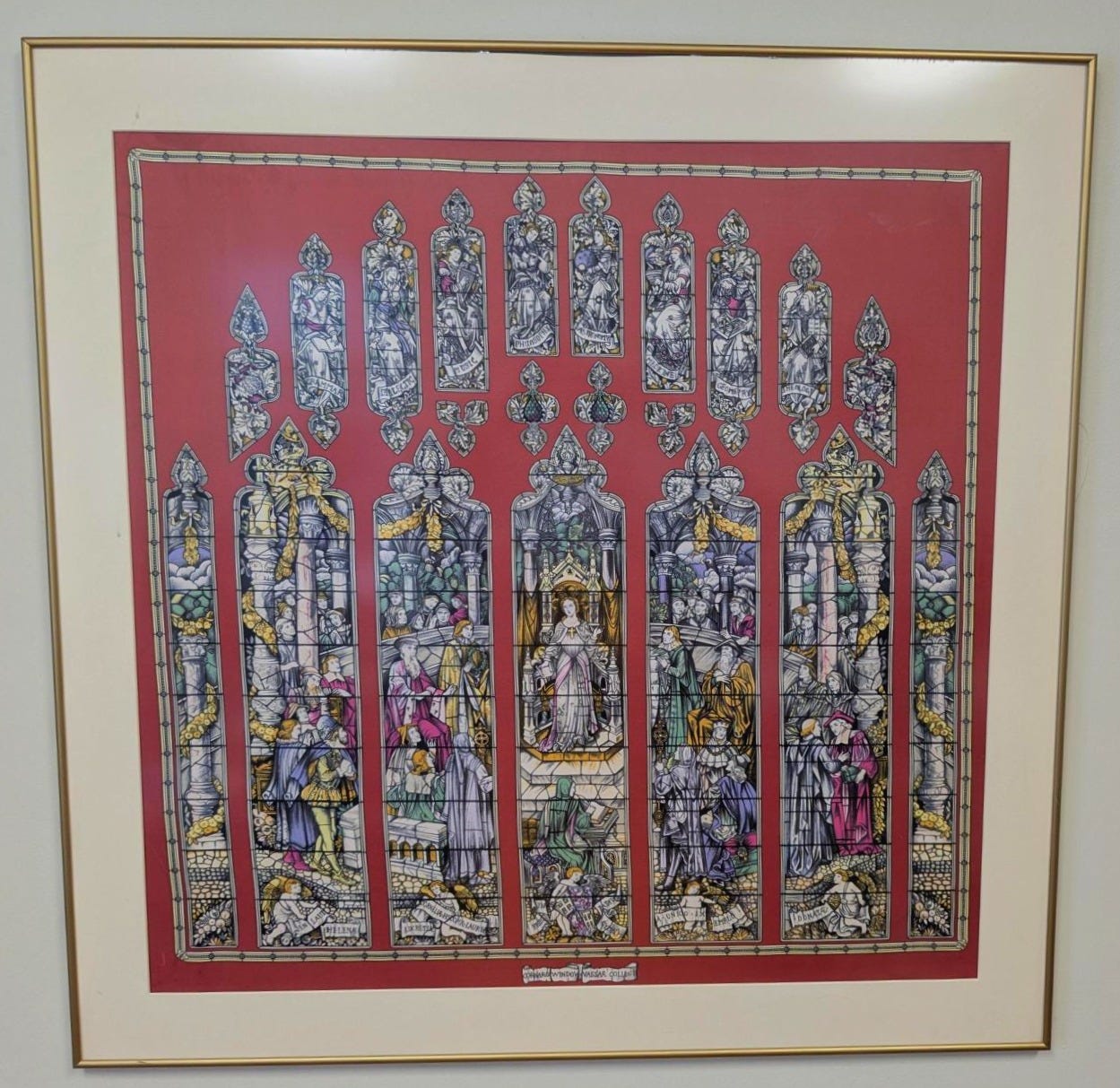
In my office, there is a large, framed scarf. You can’t tell that it is a silk scarf as the framers pressed it so well. It was a gift to me from my aunt Sherry. The scarf depicts my favorite window at Vassar. It is a large stained glass window depicting the first woman to get her PhD. She stands in the center, in a gown, gazing out over a crowd gathered, with the diploma in her hand.
Sherry was born on April Fools Day in 1941. She was born into a wealthy family, her father would run for Democratic Congressman of the Bronx. Her mother and father both were much more concerned about each other and about her father’s career than the development of their children. As a girl, Sherry was quickly placed into the role of caretaker of her younger siblings. She was exceptionally tall, like her father. But whereas height in a man was considered handsome and impressive, height in a girl made her undesirable to men. Sherry’s mom openly spoke to her about her debate as to whether they should cut the bones in her legs to make her shorter. My father, her younger brother, was often enlisted to dance with her at parties when no one else asked her.
Sherry found a handsome intelligent man to marry, and this would have been the highest achievement she could make as a woman. They had three healthy and handsome boys. But when the boys were ten, eight and five, her husband James committed suicide. Though she graduated Vassar and was so bright and well-read, the expectation was that she had to find another husband and so she did, The Reverend Dick Downes, a rather odd Episcopal priest who would become a strict step-father and eventually a mildly abusive spouse. And yet Sherry stayed married to this man for the rest of his life, enduring greater verbal abuse as he became demented later in life.
Sherry was so proud of her boys. She loved family vacations in Salem, Connecticut and talking with great abandon about each relative’s merits and faults as well as the latest gossip. She never complained and seemed relatively unaware of the fact that she never had been ablet to have a career of her own. After her second husband died, she became a leader in her retirement community, a grace-filled lover of people, she began to show more of who she could have been in a world that was not so dominated by men.
As a woman Episcopal priest and Dean of a Cathedral, I think a lot of her as I read online comments about how I am an abomination and should never be allowed to preach. I am glad that no one is suggesting cutting the bones of my legs but I wonder when, if ever, we will become a world where women can be all that God calls them to be. I will continue to gaze on that beautiful framed scarf she gave me so long ago, believing that in the resurrection life, she is becoming so much more than I can imagine.
Adrienne and I give thanks regularly for you, Kate! You embody so much of the love and nurture and intelligence necessary as a woman priest and Dean! Be dismissive of the negatives and keep guiding and leading all of us at the Cathedral and into the larger world. Ken
What a beautiful tribute to your brilliant Aunt Sherry, who smiles upon you and cheers you on, no doubt, from her place in the resurrection life. Thank you.